






















































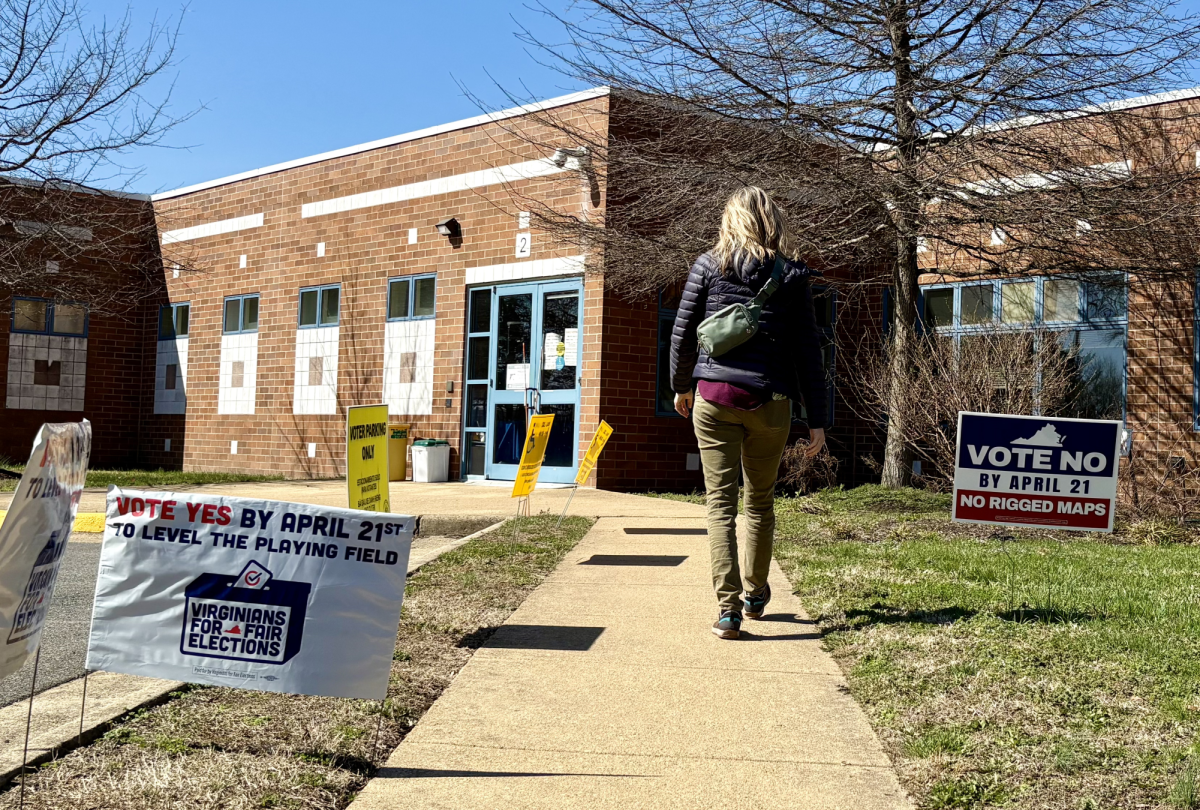
This spring, the state legislature is proposing an amendment to create a new map of Virginia’s congressional districts, and the future of Virginia’s redistricting will rest in the hands of voters. The aim of the redistricting amendment is to counteract the actions of other states’ Republican legislatures, like in Texas, where the state legislature is also trying to gain congressional seats through a new map in the months before the upcoming midterm elections.
This amendment will be brought to the people as a referendum, which will be voted on during a special election on April 21. Supporters say it may be able to turn Virginia’s 6 House Democrats and 5 Republicans into a map that would likely have Democrats winning 10 out of the 11 congressional seats in Virginia.
Typically, Virginia redraws their congressional districts every ten years following the census along with the rest of the nation by law. The last time that Virginia redrew its districts was in 2021, following the 2020 census. Usually the job of redrawing districts falls to the state’s legislature, however in 2021, Virginians voted for a new process, a bipartisan Redistricting Commission. The commission was unable to come to a conclusion before their deadline, so the duty of redrawing Virginia’s congressional districts fell to the Supreme Court of Virginia.
This year, the question posed on the referendum is “Should the Constitution of Virginia be amended to allow the General Assembly to temporarily adopt new congressional districts to restore fairness in the upcoming elections, while ensuring Virginia’s standard redistricting process resumes for all future redistricting after the 2030 census?”
Drawing congressional district lines to gain more seats for a specific party isn’t a new practice. It is called “partisan gerrymandering.” Gerrymandering is almost as old as the United States, the first instance being in 1788 when Virginian Anti-Federalists drew congressional districts to force Federalist James Madison to run against Anti-Federalist James Monroe in an unsuccessful attempt to keep Madison out of Congress.
In recent years, however, partisan gerrymandering has surged. The 2020 Rucho v. Common Cause ruling by the US Supreme Court established that federal judges cannot review allegations of partisan gerrymandering. According to the Brennan Center for Justice, “Since then, Americans have seen gerrymandering ramped up to unprecedented levels in many places—and the worst may be yet to come.”
Mr. Stefan Przywara, US & Comparative Government and Psychology teacher, shared why he believes gerrymandering has surged. “Our current environment, politically, is extremely polarized. I think in states where one party controls all the levels of government, there’s become an increasing incentive and an increasing pressure to gerrymander as drastically as possible.”
He continued on to share how this ties into current events.
“[This] especially is true since Donald Trump has become president, because he has put pressure on Republican states,” Mr. Przywara said. “So, I think Democrat-led states are responding to that.”
States currently trying to redraw their district lines ahead of the 2026 midterm elections are Florida, Maryland, Virginia, and Washington, while California, Missouri, North Carolina, and Texas have recently adopted new congressional maps.
Virginia lawmakers’ actions are similar to what California did in November 2025 in reaction to Texas’ unusually redistricting in August 2025, with Proposition 50, or “Prop 50.” Prop 50, like Virginia’s redistricting referendum, was brought before the people to vote on, and aimed to create more likely democratic seats in the House of Representatives. Prop 50 was successful in California; gaining 64.4% of the votes. According to the California Democrats page, this proposition could result in California Democrats gaining up to 5 more seats in the House of Representatives.
In Texas the issue of redistricting wasn’t brought to the people, instead, new congressional maps were passed by Texas’s legislature that targeted and changed 5 reliably democratic Congressional seats. Similarly, Missouri’s new maps came about after being passed by the state’s legislature, however there has been opposition and there is currently an attempt to bring Missouri’s redistricting to the people through a referendum by the People Not Politicians campaign.
Gerrymandering’s growth, especially in recent years, has been a major point of contention between the two parties.
Annalise Richardson, senior, believes gerrymandering’s controversy stems from the division it causes, literally and ideologically. “I think the reason why it is so controversial within American politics is because we’re always trying to one up each other, whether that is in support of one political party or not and because it affects what groups of people are represented, like if there’s mostly a majority or minorities within a district,” she said.
Opposition to this proposed amendment say that the referendum is a power grab by the Democrats in Virginia’s legislature, not an attempt at fairness as the referendum states.
Many also take issue with the phrasing of the referendum’s question.
“I see why they are framing [the question] that way, because it’s a more positive way of framing it,” Przywara said.
There are also debates about the constitutionality of the referendum. Early in 2026, the amendment was blocked by a Tazewell County Circuit court judge, on the basis that the referendum violated the Virginia Constitution’s Article XII Section 1, which lays out the procedure for amending the state Constitution. The specific part of this section that they believe was violated states, “it shall be the duty of the General Assembly to submit such proposed amendment […] not sooner than ninety days after final passage by the General Assembly.”
Mr. Przywara shared his thoughts on the situation, saying, “In general, I’m opposed to gerrymandering, because I think that it leads to increasingly polarized districts and makes for less representative government.”
However, he also acknowledged the reasons behind this amendment. “In the current environment, I do understand why the Democrat-led government of Virginia is doing this, because there are Republican led states who are doing exactly the same thing; […] this gives [Virginia Democrats] an opportunity to kind of level the playing field in that regard,” said Przywara.
With voters being asked to decide what they see as ‘fair’ for electoral processes moving forward in Virginia, Przywara voiced a viewpoint that resonates with many across America.
“In my perspective, eliminating gerrymandering across the board would restore fairness.”
When asked if he saw a possibility of this happening in the near future, Przywara said he could not.
“I am more in support of the amendment. We are seeing this happen in states such as California and Texas. […] I think we are implementing it because we see that there is this large political divide within the country. This is Virginia’s way of saying ‘if Texas is going to do this in favor of Republicans, then Virginia should do the same thing for Democrats’,” Richardson voiced another perspective shared with many.
When it comes to the future of the proposed redistricting amendment, the power truly lies in the people of Virginia. As a referendum, the amendment will be adopted if it receives a simple majority (more than 50%) of the votes.
For many West Po seniors, this election is the first they can vote in. Richardson urges students to do their research before they cast their ballots. “Do your due diligence outside of what you’re hearing on the news. A lot of the time, you’re going to get very different viewpoints […], but it’s good to go to government websites and .orgs to understand what it is going to be like in Virginia if it gets passed or not. Realistically, you want to make your own choice, and that is what I would strongly recommend, is just research. Research, all that you can.”
“It is so important to vote, regardless of how you feel about this amendment. I would encourage [readers] to pay attention to how these redistricting efforts are impacting Congress and government nationwide. If you’re not satisfied and you think that it’s not a good idea, then become more involved, because that’s the only way that things will change,” Przywara said.