






































A few years ago, West Po ranked near the bottom of Fairfax County Public Schools’ Get to Green rankings for recycling efforts. In just the past two years, however, the school has made significant progress, moving from 23rd place in 2021 place to 12th place in 2025 amongst FCPS high schools, thanks to a combination of student leadership, staff support and changes to practices.
At West Po, recycling collection is handled by students in the CAT B program. Recycling bins are located in every classroom, and because FCPS uses a single stream recycling system, all recyclable materials are placed into one container. Once collected, the materials are picked up by Fairfax County and transported to the Republic Services Material Recovery Facility for sorting and processing.
CAT B
The CAT B program at West Po is the Low Incidence Program for students with moderate to severe disabilities. The program provides an adapted curriculum that focuses on life skills, independence and career readiness. Through hands-on activities, such as recycling collection, gardening and work-based training, students gain practical experience that prepares them for life beyond high school.
Mr. Lawrence Cooper, a Work and Transition (WAT) teacher at West Potomac, emphasized the importance of the program, saying,“In this program, because I teach workplace readiness skills, we get to modify the curriculum for the program, and we do a lot of hands-on things to prepare students for their futures after high school. Over time they get used to that and learn new skills.”
A rotating group of CAT B students is responsible for collecting recycling from classrooms each day. This daily routine not only supports the school’s sustainability goals, but also allows students to practice responsibility, teamwork and job-related skills.
In addition to recycling, CAT B has more projects planned for the future.
Mr. Cooper said, “We are in the process of hopefully constructing a new pond in the empty space by the vegetable and flower beds, and have more projects planned.”
Recycling Data Show Progress
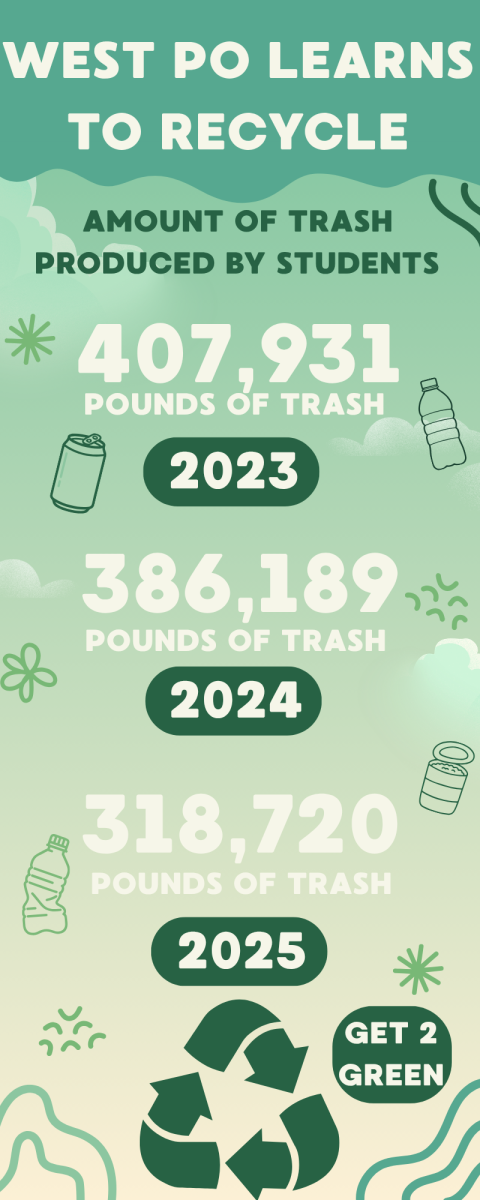
Data from the Get to Green website shows that West Po recorded its highest total waste managed in 2023, at 407,931 pounds. That same year, total trash peaked and the recycling ratio dropped to an all-time low of 17.3 percent. This decline corresponded with the opening of the school’s 600 and 700 wings, which significantly increased the amount of waste.
In contrast, 2024 and 2025 show a steady downward trend in total waste, with 386,189 pounds in 2024 and 386,734 pounds in 2025. Recycling rates during those years improved as well, rising to 20.60 percent in 2024 and 20.98 percent in 2025, the highest rates the school has recorded.
Reducing waste also has a financial impact. According to Fairfax County, disposing of trash at the I-95 Landfill Complex in Lorton, Virginia, costs $88 per ton, an increase from $66 per ton in 2019. Higher recycling rates help reduce both environmental and financial costs for the county.
West Po vs Mount Vernon
As of 2025, Mount Vernon has produced 168,580 pounds of trash and 52,807 pounds of recyclables, while West Po has produced 306,009 pounds of trash and 80,725 pounds of recycling.
For reference, Mount Vernon has a student population of about 1968 students, while West Po has a student population of about 2600 students.
This puts Mount Vernon at 85 pounds of trash and 27 pounds of recyclables per student, while West Po is significantly higher at 112 pounds of trash per student and 30 pounds of recycling per student.
Recent Changes Reduce Plastic Waste
In March 2024, West Po’s Food and Nutrition Services (FNS) team transitioned from plastic and plastic-wrapped cutlery to wooden alternatives. Through careful planning, supply chain adjustments and collaboration with vendors, the school significantly reduced its plastic use.
According to a newsletter from Superintendent Reid, as of Feb. 2025, this change alone saved more than 70,000 pounds of plastic, contributing to a major reduction in waste.
Recycling Beyond West Potomac
Statewide, Virginia’s recycling rate places it roughly in the middle nationally, at about 39.50 percent in 2024, though some regions such as Central Virginia (according to CVWMA data) reach rates as high as 58 percent. Virginia law requires larger communities to meet a minimum recycling rate of 25 percent.
Internationally, countries like Germany and states such as Maine lead recycling efforts. Germany’s 67.90 percent recycling rate is supported by systems like mandatory waste sorting and bottle deposit refunds, while Maine exceeds 70 percent through Extended Producer Responsibility (EPR) laws that shift recycling costs to manufacturers rather than taxpayers.
Student and Teacher Perspectives
Some teachers believe simple changes could further improve West Po’s recycling efforts.
Mr. Tyrone Strother, a Health and Physical Education teacher, said, “I think one of the things that could change is possibly separating the recycling bins away from the trash cans, so they’re not right beside each other. A lot of people end up putting trash in the recycling bin, and some recycling things go in the trash can.”
He suggested placing bins on opposite sides of classroom doors to reduce this issue.
Students also shared their perspectives on the program.
Senior Micheal Webster, said, “Recycling is very easy to do within a classroom because of the color coded bins, but it’s a lot more challenging out in the halls. I sometimes have trouble with knowing what goes in the trash and what goes in recycling.”
As West Po continues to improve its recycling and sustainability, the CAT B program remains at the center of those efforts, showing how sustainability programs can also serve as meaningful educational opportunities.